


By: Divya Patel ‘29 Opinions Writing Manager and Phoebe Lee ‘30 Staff Writer
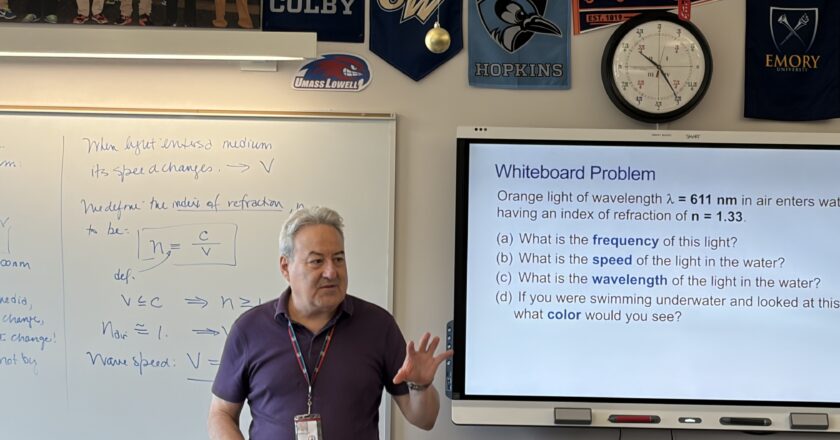
GA initiated one of the country’s first physics-first science programs in 1978. The approach follows a movement started by the American Association of Physics Teachers which re-arranges the traditional biology, chemistry, physics high school sequence.
To this day, GA continues to follow this sequence, though some students argue that GA should flip this sequence, starting with biology and ending with physics. Although many other schools do not start with physics, we believe physics first is the right foundation for students at GA.
There are many benefits to taking physics first. First, it builds the knowledge base for chemistry sophomore year. Concepts such as energy, charge and the structure of atoms make electron behavior and bonding and reaction rates easier to understand in 10th grade. Biology then builds on chemistry since cells run on chemical reactions.
This order of classes lets each course build on the last. Students who learn about energy and atoms in physics already have the vocabulary when chemistry begins. This allows students to understand why certain processes happen rather than memorizing them.
Secondly, physics also trains students to think critically and logically. Solving a problem is not just memorizing the steps but identifying what is known, choosing a strategy and understanding each step. This forces students to slow down, question their assumptions and explain their reasoning. These are skills that carry over to chemistry and biology as well.
Students can develop better study habits and time management through this sequence as well. Physics class requires steady, repeated practice, so cramming the night before a test rarely works. Learning these habits in 9th grade pushes students to build routines that last through their time in Upper School and beyond.
Although some may view this course arrangement as an intense amount of rigor and daunting, there are numerous benefits. The practices you learn from a physics class in freshman year creates a strong foundation for the rest of high school.
The physics-first program can also aid you to discover interests that you may want to pursue later in life or school. If you enjoy mechanics, engineering, or similar concepts this course structure allows you to dive deeper into these topics in advance. The labs that occur involve working together and using a logical mindset.
Beginning the Upper School science curriculum with physics can be a lot for 9th graders, but it gives them a way of thinking through chemistry, biology and beyond. Even though it may seem like a daunting course at first, in the long run it helps students manage their time better, create better study habits, and continue to succeed throughout their years in high school.