
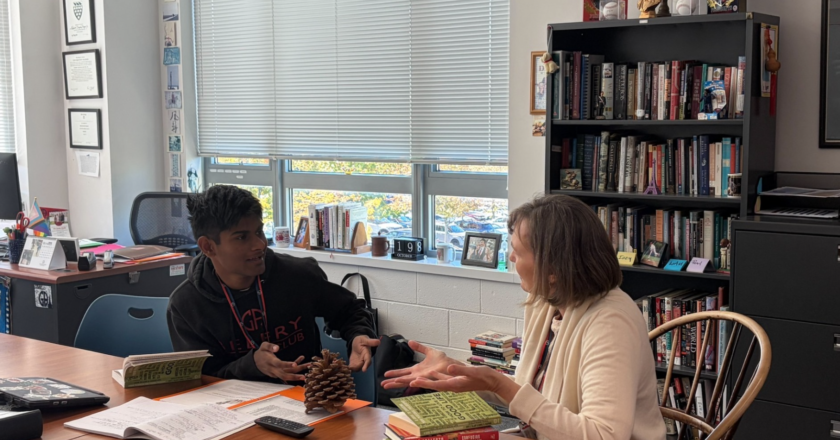


Have you ever seen seniors talking to trees on the quad? If so, you might have just seen Dr. Julie Kimmel’s philosophy class.
Only open to seniors, the class asks students to stop and question how they live. The semester-long course centers around two questions: How do you have a good life? And what does it even mean to be human? By the end of the semester, students are able to answer these heavy questions with full confidence.
“It’s also something that I kind of want to apply in college when we are surrounded by A.I. I think it’s important to be able to critically think like that,” Maya Rosenzweig ‘27 said.
Dr. Kimmel’s interest in this topic started in college when she first took a philosophy class. At the time, she had hoped the material would offer a way to navigate some of the more uncertain aspects of life.
“It’s so relatable, and I found it really expanded my perspective and made me less anxious about everything that was happening during the pandemic,” Dr. Kimmel said.From Dr. Kimmel’s viewpoint, a strong philosophy can be extremely applicable outside of the classroom.
The syllabus includes books from philosophers dating back to Ancient Greece, like Aristotle and Socrates. Students also cover topics like Confucianism and Taoism.
“It’ll also broaden your perspective, and I think ultimately can make you a better member of a community or a society,” Kimmel said.
Philosophy is more important to our lives than we think. According to Dr. Kimmel, philosophy gives you the ability to ask questions and apply solutions to real-life scenarios.
The students’ final project is to write an essay about their philosophy of life, and to also have a fifteen minute discussion with Dr. Kimmel, challenging the students’ personal philosophy.
She hopes that by writing this essay and participating in this discussion, students will be able to look to their own philosophy to help them articulate ideas, resolve obstacles, and build a new perspective on life.
Philosophy teaches students to think independently, a skill seniors will rely on as they begin making their own decisions in college and beyond.