

Ezra Blades ‘27
On April 29, the Supreme Court struck down Louisiana’s Congressional map that provided representation for minorities, specifically African Americans in central Louisiana. Responses have gained traction, with discussion on the importance of racial representation in state-wide and federal governance.
Efforts to provide minorities voting influence and Congressional representation took action during the Civil Rights Movement.
The Voting Rights Act (VRA) of 1965 was designed to eliminate discriminatory voting practices used against minority voters, mainly African Americans, in the South. Over time, enforcement targeted racial districting, or the redrawing of district lines based on racial demographics, creating opportunities for minorities to elect their representatives in Congress.
In 2020, Black voters filed lawsuits against the state of Louisiana, stating that the existing map had diluted Black voting power and given less opportunity to Black voters in central Louisiana. Violation of Section Two in the VRA is most commonly quoted in response to the Supreme Court’s decision.
Section Two states “the political processes leading to nomination or election in the State or political subdivision are not equally open to participation by members of a class of citizens protected by subsection of this section in that its members have less opportunity than other members of the electorate to participate in the political process and to elect representatives of their choice.”
In 2024, the state added two additional black-majority districts, which consequently led to the election of Troy Carter and Cleo Fields, the first two Black Congressmen in decades.
However, on April 29, the 2024 redistricting and Civil Rights Act was challenged in Louisiana v. Callais, headlined by a 6-3 Supreme Court decision in favor of Louisiana. The Supreme Court decided that the pre-2020 Louisiana district map did not violate the Voting Rights Act, and therefore, the newly drawn majority-black congressional district was seen as constitutionally unjustifiable.
Other specific reasoning states that race-aware mapmaking is still a form of racial discrimination, regardless of intent, quoting the Equal Protection Clause of the 14th Amendment.
There are several responses to the Supreme Court’s response and justification for their decision.
“We aren’t going to be able to have representation. It’s really important in the local government, school board, state senate and state representatives,” Ms. Melissa Fikioris, faculty sponsor for Black Student Alliance, said. “Nationally, it has a huge impact too, but it’s really the day-to-day. So I know it can seem like somebody else’s problem, but it’s not.”
“It’s unfair; it’s silencing a whole [African-American] community, but somehow it’s still legal,” Ki Robinson ‘28, a BSA member, said. “It’s pretty frustrating.”
Robinson and Ms. Fikioris are among many disappointed American citizens. Civil rights groups like the National Association for the Advancement of Colored People Legal Defense Fund have publicly criticized the Supreme Court’s ruling, stating that it is not a ruling of constitutional order, but a means to prevent minority influence on federal elections in the South.
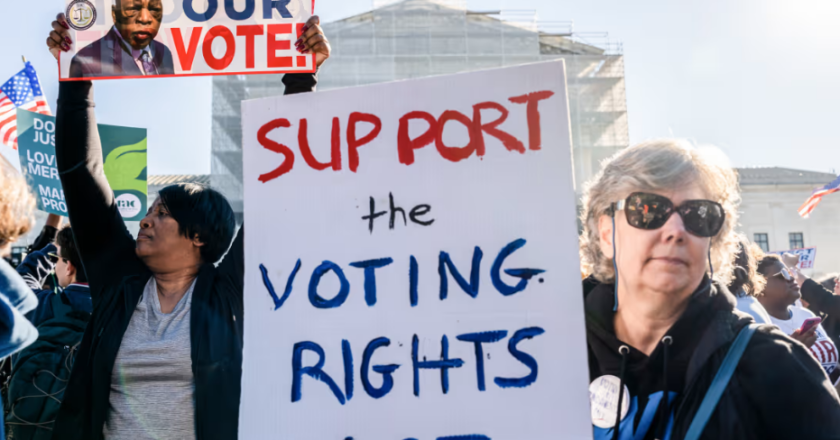
Protests endorsed by the NAACP have flared up in response to the decision, with more than 5,000 voting rights activists in Selma, Alabama gathering to address the issue.
Louisiana v. Callais does not provide immediate changes to Pennsylvania districts, but it will challenge future decisions on racial districting.
These court decisions will also bring rippling effects to Germantown Academy’s classrooms.
“As a history teacher, this kind of thing shows how we have to end up changing the way we teach things. Everything’s always changing, and the way that we look at the past is heavily shaped by what we see in the present,” Dr. Matthew Bunn, Upper School history teacher, said. “Our place in the world today matters, and the way we look at the past matters. And they’re not two different things, but rather just the same thing connected.”
With the 2026 midterm elections coming up, the effects of Southern racial districting and representation in congressional government remain to be seen.
https://www.scotusblog.com/2026/05/court-gives-immediate-effect-to-voting-rights-act-decision
https://www.archives.gov/milestone-documents/voting-rights-act
https://www.brennancenter.org/our-work/research-reports/louisiana-v-callais
https://campaignlegal.org/update/us-supreme-court-has-eviscerated-voting-rights-act-whats-next