
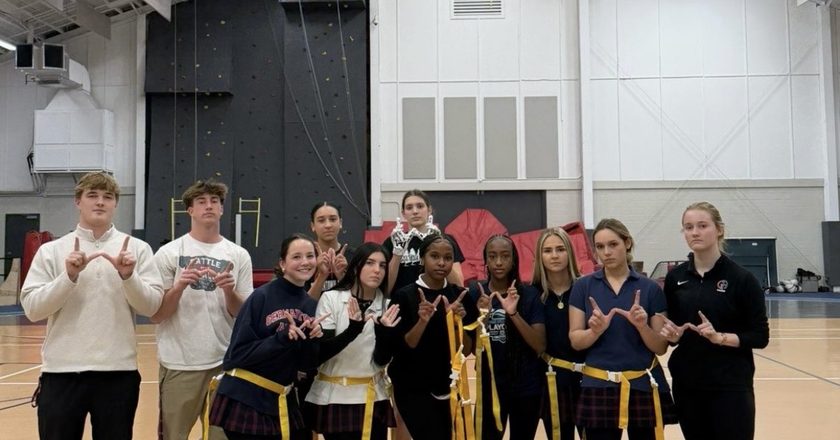



Over the past couple of years, Germantown Academy (GA)’s Student Government Association (SGA) has held February Flag, a tournament in which female students from every grade can compete with each other on a stage that is not represented otherwise in the GA community. Around the United States, Flag Football has become increasingly popular among females and is now a varsity sport in 16-17 states. Now, the fever of GA’s version has swept over the entire Upper School.
GA’s Upper School recently hosted a student-led flag football tournament that brought girls in every grade together in a fun event. Catalina Urrutia-Lozano ‘28, a participant, shared her views and insights on the event.
The game followed classic flag football rules–no tackling whatsoever.
“Every grade had practices before,” Urrutia-Lozano said. “My grade only had seven girls before our coaches recruited more people. And then we had practice to figure out what people were good at. It was just football, but no tackling.”
As the event loomed, preparation was key to success. Teams held lunch-flex period practices to build cohesion and strategy. Participants even made group chats to stay connected.
“We made a group chat to figure out what we were going to wear. We decided to do all black,” Urrutia-Lozano said. “After we won the first one, we had another practice.”
An important element that elevated the experience was that it was student-coaching rather than traditional teacher-led guidance. Urrutia-Lozano praised this approach for making the competition more enjoyable.
“I thought student coaching was better than a teacher coaching it because it’s your actual classmate or friend,” Urrutia-Lozano noted, “If you made a mistake and your coach said something, you don’t feel as bad.”
Compared to other GA events, this tournament felt fresh and really student-led. “I liked it because it was well-organized and a lot of people showed up to it, and I think it was different because it was student-led,” Urrutia-Lozano said.
This event demonstrated how committed GA was to students to drive their work. As one participant’s reflections show, these events not only build skills but also strengthen a community’s bond.
Matthew Hadlock ‘27 signed up to be a student coach because he feels it is his responsibility as a football captain to represent the team well. He sees coaching as a way to support the program and encourage leadership within the GA community.
“As a football captain, I kind of thought it was my duty to represent the football team as well as possible,” Hadlock said.
In addition to his decision to coach the team, Hadlock gives credit to his players, asserting that many of them weren’t difficult to coach because they were so athletic through their experiences in their respective sports. He explains that having teammates so familiar with competition leads to a more productive and efficient connection between student coaches and their players.
“I’d say it wasn’t that difficult. Our class, our grade [and] our team were very athletic, very diverse in the sports they played,” Hadlock said. “You know, when you have people like Jo Owens [year], who are very familiar with the sport. Other girls that are very athletic too, that are also [Dimension-one] D1 in their respective sports make coaching a lot easier.”
Tess Partyka ‘26 explains the SGA Activities Committee’s thoughts on why flag football was brought back to the community, attributing the return to the strengthened connection between the GA community that follows the tournament. According to Partyka, the committee focuses on creating events that lead students to come together in collaborative participation as a school.
“In student government, in the activities committee, we strive to do things to bring the community together,” Partyka said. “So we had done one of these things previously, and we thought it would be a great idea to bring it back so everyone could come together.”
The effect the tournament has on the GA community is more than just bringing people together, though, Partyka thinks. Through the community gathering together to enjoy, participate, or coach the games, the overall school spirit and engagement for future activities increase. She notes that this was clear after witnessing her peers cheer players on and getting involved in the competition between grade levels.
“I think during the event when a lot of students showed up, it was really fun to cheer on your peers and watch everyone get super into it,” Partyka explains.
All-in-all, it is clear from the responses from the GA community that the return of the February Flag was a huge success. From students competing, coaching, cheering on or organizing the event, everybody had positive feedback on the tournament’s influence on school spirit and competition to take away from the stress of the final stretch of the school year.