

President Donald Trump’s administration has launched investigations into nearly 100 colleges and universities, jeopardizing billions of dollars in research grants, institutional contracts and academic partnerships. Many schools now face the possibility of losing access to essential federal support, with little warning and limited explanation.
The cuts have hit institutions like Harvard University, Cornell University and the University of Pennsylvania the hardest, where research labs rely heavily on federal grants to survive. Without that funding, students have lost jobs, projects have dissolved and early-career researchers are left questioning their futures in science.
The move has sparked outrage and disheartenment from faculty and students nationwide and raised alarms for high school and college students preparing to enter a higher education system.
“I was pretty surprised,” Aidan Gor ’25, University of Pennsylvania (UPenn), said. “From the perspective of someone who does a lot of research, it seems counterintuitive for someone to cut that funding because there’s a lot of work being done that is very beneficial to vulnerable people.”
Many of the administration’s investigations target compliance with Title VI, a section of the Civil Rights Act that prevents discrimination in federally funded programs. While the Department of Education claims it is enforcing fairness, critics argue that the real goal is using Title VI as political leverage, silencing institutions that oppose Trump’s agenda while targeting elite universities labeled as liberal.
“The basis of the liberal arts education, in my experience, is intellectual inquiry and challenge,” Mr. Robert Moyer, Upper School history teacher, said. “That can be scary to individuals who are in power, but that’s what you’re supposed to do. Federal grant funding is tremendously important to this research— if you defund it, you destabilize it.”
Universities are responding in different ways. Some are pushing back while others are staying quiet, fearful that speaking out will cost them more.
“Each university has its own approach to these cuts,” Jason Wang, GA ‘22 Alumni and student at Yale University, said. “Either we’re going to stand, we’re going to receive these cuts, and we’re going to very vocally push against the government, or stay as low, quiet, and nonpartisan as possible. That’s precisely what Yale is doing as an institution at the moment. “
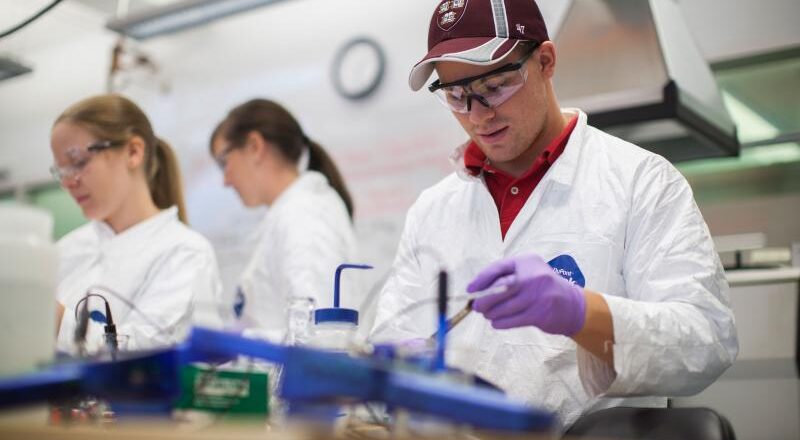
For students on campus, the impact is even more visible. Labs are closing. Internships are disappearing. Undergraduates are being told there is no money left to hire them.
“A lot of my friends are continuing research after college in the lab, but they can’t anymore because that lab is either being dissolved, or they don’t have any money for their projects to hire them,” GA ‘21 alumna and Harvard student Sarah Rojas said. “It’s affecting grad students, principal investigators, and undergrads who are looking to go into careers in science.”
The consequences go beyond lab closures. They are beginning to shift how students choose their majors and career paths. Some students may step back from science altogether, fearing a future with limited opportunity and support.
In the coming years, there will be fewer funded internships, fewer lab positions and reduced graduate school spots. The uncertainty could reshape how selective institutions allocate financial aid, conduct research and interact with the government.
“I’m most worried about the freshmen having to rethink pursuing a career in science because it’s not being valued by the government, or it might not be funded when they graduate,” Rojas said. “At every institution, especially here, I feel like there’s definitely a pressure to have a job after graduation, and an excitement as well to take what you learn and apply it to the real world.”
And for high schoolers watching from afar, these changes raise sobering questions: What kind of universities will we enter? Will we have the same opportunities to research, discover and innovate?
“It was very sad to see almost $2 billion in funding being cut,” Rojas said. “In a government like ours, where we put our money is where we put our value. So if money isn’t being put towards science, it feels like we’re devaluing science itself.”