
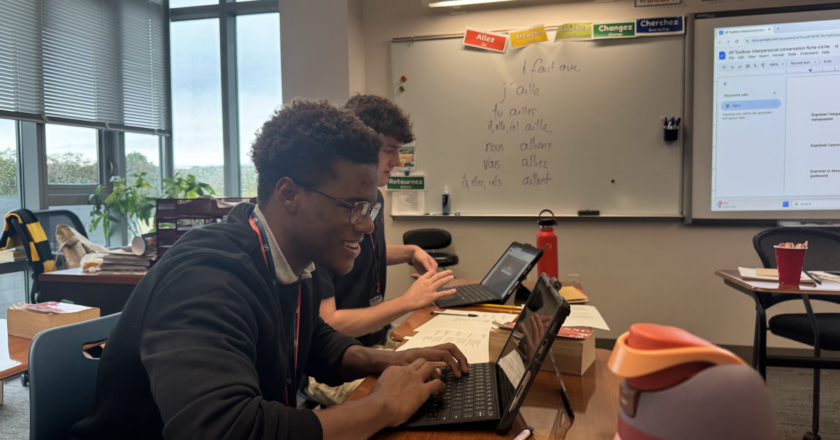


Typically, Germantown Academy courses take an anti-AI stance, but the language department has a different approach. In Chinese, French, and Spanish classes, the use of chatbots, mock conversations and vocabulary practice are often encouraged. What is the rationale behind this, and how is it different from AI usage in other subjects?
For language classes, AI is a powerful tool that can help students learn grammar, how to interact in daily scenarios, and practice the skills they learn in class. Programs such as ChatGPT and Sidekick AI provide useful practice to simulate discussions when talking with a real person isn’t a possibility, and to learn basic ideas of skills that can later be polished in class.
“I asked [my students] to use ChatGPT, to research, practice, explore and apply first. Then, we start to go over those things [in class],” Ms. Tsung Tsai, the Upper School Mandarin Chinese teacher, said. “We’re using AI as a tool, so they take more responsibility in becoming an active learner, instead of passive.”
In other subjects, anti-AI restrictions are established in order to keep learning as authentic as possible, and to avoid students blankly copying and pasting rather than learning the material themselves. However, for language classes, the usage of AI as a resource rather than a shortcut has helped students learn more efficiently and effectively.
“I noticed that it motivates students more, because students like the hands-on learning,” Ms. Tsai said. “Students actually learn deeper than for me to just present it to them. My classroom seems better, and students are more engaged, because it’s like students are researchers.”
While AI programs like ChatGPT and Sidekick will never fully replace a teacher, it is beneficial to use this resource. Pairing both traditional learning with the usage of AI as a tool helps us make the most of such a valuable source, and establishes how students can use it the right way.
“I think as a school, we should embrace AI to keep in step with the time. We cannot say ‘this is not good’, but basically [we should] look from different perspective, as ‘how do you appropriately, properly use AI?’” Ms. Tsai said. “For example, I use AI as a tool, not a shortcut, therefore, students need to do active research.”
Students have also found AI helpful toward their learning. Not only has AI proven itself to be great at generating practice and a useful teaching resource, but another upside is its swiftness. AI can provide instant feedback and rapidly offer deeper explanations on course material.
“I also think [AI] is efficient because if you have any follow up questions, you can just ask it right away and get immediate feedback,” Emerson Choudry ‘27, a Chinese Four Honors student said.
While many classes restrict AI use to preserve academic authenticity and integrity in learning, the language department demonstrates how this technology can actually enhance education instead of distracting from it. By integrating AI into their classrooms, language teachers and students can take advantage of this powerful tool to learn more productively and proficiently.