
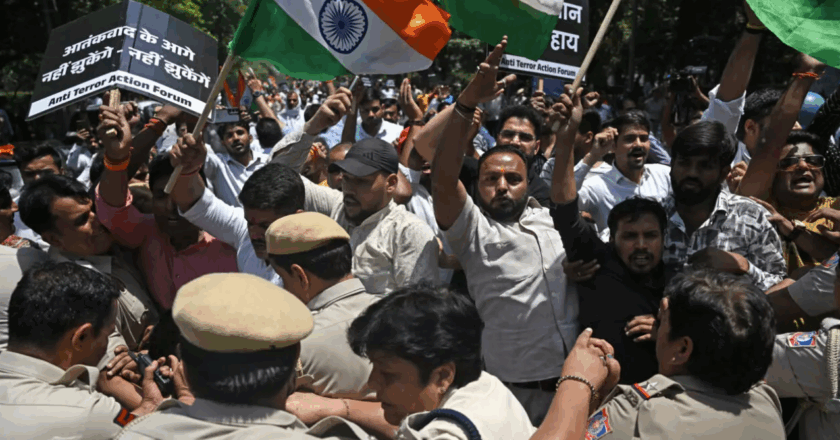


On May 7, rising tensions between India and Pakistan escalated to armed military conflict in Kashmir, a territory on the border partially controlled by both countries. But before the conflict spiraled into a full-scale war, a ceasefire agreement was reached on May 10.
India and Pakistan have had a long history of conflict in Kashmir. Since 1947, three wars and many skirmishes have taken place in this piece of land, but eventually a Line of Control (LoC) was created in the 1972 Simla agreement.
Even with the LoC, there have still been small conflicts in Kashmir. Most recently, on April 22, a bombing also occurred in Pahalgam, a town on the Indian controlled side of Kashmir, killing 26 people.
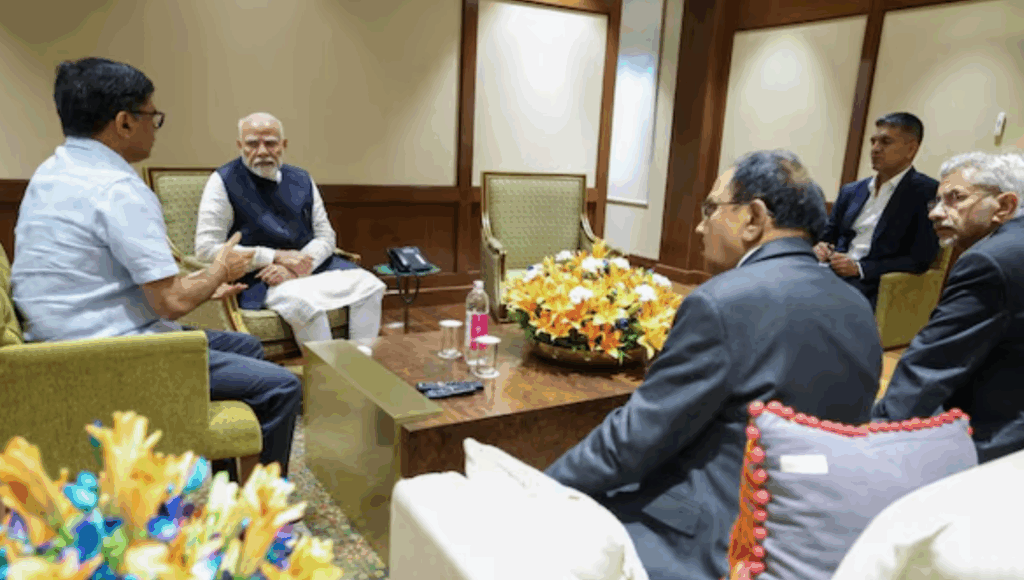
Two terrorist groups, backed by Pakistan, Jaish-e-Muhammad and Lashkar-e-Taiba, claimed responsibility for the attack.
In retaliation, on May 7, the Indian Air Force launched an aerial raid, targeting locations with terrorist infrastructure and hideouts.
For the next three days, the conflict began to escalate. The countries engaged in a four-day military conflict, including artillery shelling, missile strikes and drone attacks.
On Saturday, May 10, President Donald Trump announced a full and immediate ceasefire was reached between the two countries.
But even with the ceasefire, tensions between India and Pakistan are still tense:
“There’s no guarantee that there will not be violence, religiously-based violence,” Upper School History teacher Mr. Robert Moyer said. “And that’s what’s been happening.”
According to him, the root of the current political instability stems from the poorly-resolved partition, with India controlling nearly half of the region, Pakistan controlling one-third and China controlling the rest.
“This whole region was never unified effectively politically. when those imperial controls broke down…you saw different groups who want to basically rule themselves,” Mr. Moyer said.
Both India and Pakistan are nuclear-armed, intensifying the danger even more:
“There’s just a real period of heightened nationalism,” Mr. Moyer said.”And groups really believe that this is their opportunity to assert their independence.” Despite diplomacy, many still worry about how long the peace can be maintained.
For students at GA, the India-Pakistan conflict may feel distant, but for other students, this conflict can be affecting their homes. Sophomore Nayan Shah ‘27, whose family was born in India, shared how the recent conflict and violence has led to conversations regarding his family in India:
“Even though they don’t live near the border, it can be scary knowing some of my family is nearby,” Shah said.
Instead of focusing on the political aspect, Shah mentioned how it’s more important to empathize rather than getting caught up with the facts:
“You don’t have to know everything about the conflict right now to show you care,” Shah said. “As long as you make an effort to understand that many families in both India and Pakistan are being affected, that’s all that matters.”
Even though a ceasefire has been reached, tensions are still high, and further diplomatic efforts by India and Pakistan are needed to create peace in the Kashmir region.