
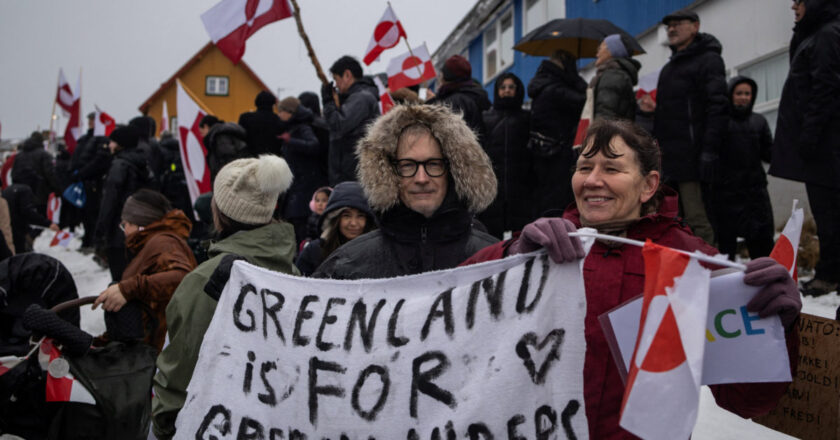



Greenland, an autonomous (uncontrolled) territory of the Danish Kingdom, resides deep inside the Northern Hemisphere. As the largest island in the world, roughly nine times larger than the United Kingdom, its strategic position between the Arctic and Atlantic Oceans makes it not only an indispensable military and naval base for any world power, but also a key economic asset.
Greenland’s proximity to the North Atlantic oceans gives it high strategic importance as a territory. Its key location would allow for greater advancements in missile defense from Pituffik Space Base.
Emerging trade routes in the Northern Hemisphere would mean that U.S. control over the Greenland Sea could generate over an estimated $1.8 billion dollars. Travel distances could decrease immensely (40% from New York to Shanghai) and the estimated oil and gas required to run the ships would decrease by another 20% (compared to through the Panama Canal), according to the National Oceanic and Atmospheric Administration (NOAA).
President Harry Truman viewed postwar Greenland as a prime location for permanent U.S. military assets that could detect and counter major air strikes—including nuclear strikes—by the Soviet Union during the Cold War.
In addition to its strategic location, Greenland is also eyed as a potential source of significant mineral resources, such as rare-earth elements and significant crude oil and gas reserves. Greenland holds some of the world’s largest deposits of rare-earth elements (REEs).
If fully developed, as it remains largely untapped, it could become the second-largest resource depot in the world, with an estimated total resource worth of $1.1 trillion. This will prove to be an economic blessing to the United States, aiding it in its goal to reduce reliance on Chinese and Russian assets.
However, the annexation of Greenland, a territory of the Kingdom of Denmark, would be the direct seizure of a nation under the North Atlantic Treaty Organization (NATO). Greenland falls under NATO’s collective defense (Article 5). Therefore, a U.S. annexation would violate the core principles of the alliance.
Annexing Greenland, while immensely profitable for the United States, especially with the recent capture of Maduro and seizure of oil operations in Venezuela, clearly violates international law and the United Nations Charter (UNC).
However, we are the United States. We have established law that transcends geopolitical boundaries through international agreements and customary practices. Since the U.S. establishes the law, it also claims the authority to override it when it thinks it is necessary.
The US intervention in Venezuela illustrates this perfectly. Even though multiple countries condemned the US extradition of Maduro, none took direct action. Even the US’s greatest adversary, China, only issued a mere condemnation.
However, the annexation still entails a greater risk for the cohesion of US security alliances. Distrust in NATO could lead to the separation of European countries and the major Western alliance. Russia and China, major world powers on the Eastern side of the globe, could frame the US threats as unreliably “hegemonic”, potentially recruit nations to join the smaller, but growing, alliance BRICS.
The annexation also is a potential for an escalation in tensions between the US and its adversaries, for seizing Greenland could potentially destabilize the relationship between the United States and Russia. Territorial disputes, such as the control of the Lomonosov Ridge, could escalate world-power competition in the Arctic region.
Despite this, the potential annexation of Greenland opens a new frontier with innumerable benefits for the good of the American people. The United States could control two of the world’s largest oil reserves (Venezuela and Greenland), making it one of the largest, if not the largest, natural resource holders in the world.
Moreover, control over Greenland could lend more superiority to the United States Air Force and United States Navy by granting more military bases in the Arctic Circle and allowing more advanced reconnaissance missions by satellite.
Not only could this be a large proponent for fifth-generation fighter jets, but it could also lead to the retirement of reconnaissance planes such as the U-2 Dragon Lady; aircraft such as these have already been shot down over Russian airspace.
Along with this statement, several European nations have sent delegations to protect the island of Greenland as part of Operation Arctic Endurance. Germany sent a delegation of thirteen reconnaissance soldiers. France sent fifteen mounted infantry units. Sweden sent three military officers. Norway dispatched two military personnel. The United Kingdom sent one military liaison.
Against the United States military, the most powerful and advanced in the world, the total 37 military personnel sent by European nations can be looked upon as a largely ineffective attempt to deter American interests, and a threat from much of the EU that posed limited practical risk (CNN News).