
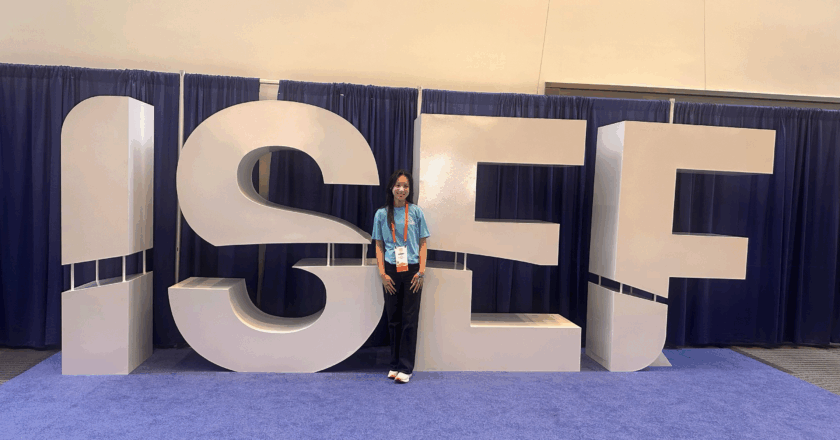

This spring, hundreds of students from across the county came together in the Germantown Academy Field House to present their science research. Among these was Audrey Yu ‘26, whose hard work, passion and dedication led her to create one of the most successful projects in that room.
“To come up with your project, you have to ask a question about something you’re really interested in, and then try and come up with an answer,” Yu said. “How can we use math to make cancer prognosis more precise, personalized and accessible? That’s kind of what I asked myself, and that’s how I came up with this project.”
Starting from the summer and continuing until this spring, Yu has dedicated a significant portion of her time to Independent Science Research, spending countless hours researching, designing and crafting a complex, award-winning project.
The independent science research program at GA is a half-credit elective course. The students meet individually with Ms. Sarah Kesten, director of the Independent Science Research program, twice a rotation from the fall until the spring to create a science fair project.
This course provides students with the opportunity to attend a series of science fairs. All participants are eligible to attend two fairs: Pennsylvania Junior Academy of Science, or PJAS, and Montgomery County Science Research Competition, or MCSRC.
MCSRC provides students with the possibility of earning special awards from various organizations, as well as category awards. Students earning a first, second or third place category award advance to the next stage: the Delaware Valley Science Fair, or DVSF.
At DVSF, the students are provided with another opportunity to present and be rewarded for their hard work in various categories with special awards. Then, three first place category award winners of DVSF from each grade will be awarded an overall first, second or third place award in their grade and advance to the International Science and Engineering Fair, or ISEF.
This year, Yu placed first out of all the juniors at DVSF and took part in ISEF in May. ISEF is an extremely prestigious fair, bringing together talented researchers from around the world. It is a unique opportunity for skilled scientists of all ages to demonstrate their talent and create rare relationships with others who dedicate their time to the same things.
“[ISEF] is very competitive, but also very inspiring,” Ms. Kesten said. “You get a lot of ideas seeing that level of research going on.”
For her project, Yu developed multiple mathematical models to predict personalized breast cancer prognosis, integrating both clinical and molecular data to better guide patient treatment. Her project was a complex analysis that uniquely combined many previous studies to generate mFore accurate predictions.
In this project, Yu was able to combine both her passion for mathematics with her interest in medicine and cancer research.
“I chose this project because I was really interested in applying math to healthcare,” Yu said.
This biomedical aspect of Yu’s study was a sophisticated and unique way to look into more comprehensive ways of predicting breast cancer outcomes.
“When scientists do a cancer study or any medical study, they might look at a few different variables, and then another group of researchers will look at other variables, still with cancer, and others will look at other variables,” Ms. Kesten said. “So what Audrey did was look at a whole bunch of different studies and see what variables all the studies looked at to cobble together a great big data set.”
To utilize all of this data, Yu created several Bayesian network models, which are mathematical models that visually represent and combine the probabilities of certain variables affecting an outcome, leading to a prediction. In this case, Yu investigated whether a patient’s data produced a predicted outcome of either a good or poor prognosis. Yu wanted to determine which of her models was the most accurate.
For her first model, Yu limited the data set to only clinical factors. This model was the most similar to those used in practice today.
Her next model was a partial data integration model, where she incorporated both clinical and genomic data, but only allowed them to contribute independently and directly to the prognosis, restricting interactions between variables.
The third model was a full data integration model, which also utilized both clinical and genomic data. This model captured the cross-omics interactions, allowing for both direct and indirect contributions to the prognosis outcome.
The final model was a Markov blanket, which allowed interactions between variables but only included the variables that directly contributed to the outcome.
Yu measured the success of each model in four different ways, and also validated them with an outside data set. She concluded that the full data integration model was overall the most accurate, followed by the partial data integration model, then the Markov blanket, and finally the clinical only model. The clinical only model performed very poorly compared to the others, which all incorporated both molecular and clinical data.
This year, Yu’s success was attributed to many factors, but one important aspect was her passion for STEM.
“She clearly loves all aspects of the sciences,” Ms. Kesten said. “She sort of approaches her projects with joy and curiosity.”
In previous years, Yu has also demonstrated her passion for applying math in medicine with her project on forecasting measles outbreaks in the US. Her past experiences with science research paved the way for her accomplishments, teaching her many important lessons.
“Don’t focus on getting a prize,” Yu said. “Just go with your passion and do what you like. That’s how you get a really good project, because if you like what you do, then the judges and everyone else will too.”