




Typically, the usage of artificial intelligence (AI) in academic classes at Germantown Academy has been discouraged and sometimes outright prohibited due to the lack of academic integrity that often results from its usage.
The possibility of violating the honor code, facing the Honor Council and acknowledging an honor offense on one’s college transcript pushes students to submit their own honest work.
However, many faculty members, most notably those at the GA Changemakers Institute 2025, have acknowledged the benefits of AI to improve studying, explain class concepts clearer and guide students through challenging projects. This complicates the previous one-sided perspective of most GA Upper School teachers, who argue that AI should not be used at all as a tool, no matter how resourceful it may be.
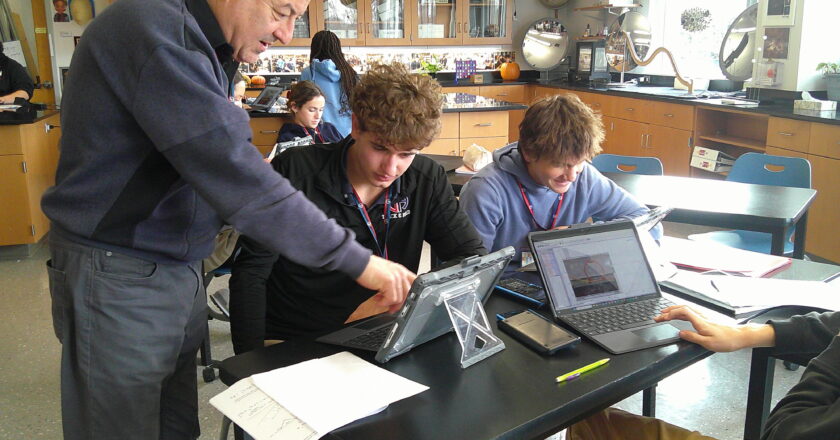
Dr. Victor J. Montemayor, an Upper School physics, mathematics and astronomy teacher, is one of the first of few teachers to formally allow students to harness the power of AI for a project.
Having received a grant from the Germantown Academy Science Program concerning the usage of AI in classrooms, Dr. Montemayor sought to implement large-scale Open AI models, such as ChatGPT and Perplexity, in his astronomy class, where students will be tasked in February with the monumental job of designing a rocket ship and a fully functional colony to inhabit Mars.
“As opposed to everything else at GA [as far as AI is concerned], which seemed to be pretty much the instructions of ‘no’, this [project] was the opposite,” Dr. Montemayor said.
Such a task, involving logistical hurdles including waste disposal systems and meeting nutritional and oxygen requirements is quite challenging. Despite its lack of human-level creativity, AI is better at high-level processing and analysis. This is precisely why AI can serve an important purpose in ensuring that all of these conditions are met and understood in this challenging astronomy project.
Through conversations with ChatGPT, students were not only able to understand how to construct such a Mars colony but were also ultimately able to learn and discuss concepts not covered in the actual astronomy course itself. Additionally, students were able to learn how to guide the AI to the intended, detailed answer, not merely a generic suggestion.
“[The project is] an opportunity for the students to get exposed to ideas that they wouldn’t have been exposed to otherwise,” Dr. Montemayor said. “The other goal was to get them interacting with AI and really see what it can do – that it takes work to get useful information from it.”
However, Dr. Montemayor also recognizes that AI should not be used in most academic settings, particularly in history and English classes.
“Obviously, just getting AI to write things for you is defeating the whole purpose [of history and English classes],” Dr. Montemayor said. “You’re supposed to be learning how to write and put things together.”
Through using AI, the purpose of English and history classes become meaningless, since individual writing is a fundamental tenet that must be perfected, not infringed.
This process of being able to wrangle with AI is a critical skill that students will absolutely have to learn down the road, as the conditions of the 21st century make it nearly impossible to avoid their effects.
Through embracing AI as a tool rather than forbidding it as a manifestation of academic dishonesty, Dr. Montemayor ensures that his students will be well-prepared to understand and optimize the benefits of AI to accomplish their respective future tasks with greater precision and productivity.