

GA explains Speech and Debate Club
Alex F. Alicia S. Angela Y.
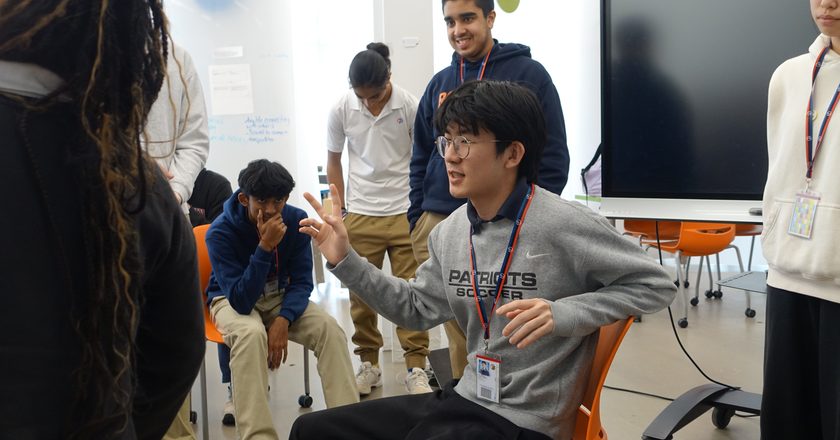
When it comes to public speaking, there are many paths to choose from. Speech and debate is a popular extracurricular activity where students develop communication skills through speaking and discussion exercises. Germantown Academy’s (GA) Speech and Debate Club focuses on teaching its students to both speak with confidence and openly share their ideas with others. Through practice, public speaking can turn from being a nerve wracking idea to a more comfortable habit used both in and outside of school.
The Speech and Debate Club has continued being an active club at GA . Meeting two to three times a rotation, it is able to introduce the activity to new students as well as give veterans a space to practice. This club offers more than just practice sessions for their respective events–it can help people get used to talking in front of large crowds, which is an important life skill. Speech and Debate can often be confused as an only argumentative club, but there are multiple sides to it.
“Speech and debate can be diverse in terms of opportunities it offers students; there may be a sense of ambiguity around what speech and debate is or isn’t,” Mr. James DiFranco, faculty sponsor of the club said. “One of the goals moving forward is to consider ways we can clarify this for students.”
Speech events which include poetry, drama and traditional oratory. Participants research pieces and perform in front of an audience with the goal to deliver an emotional connection by using expressive and physical language.
Speech is led by Ashley Wang ‘26 and Lauren Kim ‘27. Members describe Wang and Kim as devoted leaders in speech who will try their best to help students interested in speech to excel at it. They believe that teaching students is about finding ones who are devoted to learning about speech or debate and help them break out of their shell.
“It’s so fun seeing kids that go from ‘I’m too shy to talk’ to full on tumbling on the ground and crying,” Kim said. “I just love seeing that change.”
Debate is split up into Lincoln Douglas debate (LD) and Public Forum debate (PF). LD is a one-versus-one debate focused on philosophy and ethics. LD requires students to defend topics such as justice and morality, while maintaining the fast-paced speaking style.
“I started out by doing debate in freshman year, and it’s helped me grow a lot as a student in terms of my speaking and research skills,” Chloe Zhou ‘26, Lincoln Douglas debate captain, said.
PF is a partner-style debate focused on current events and policy making. It challenges students to understand real-world issues and have a good idea of policy proposals. It is generally described as less technical than LD, requiring broader understanding, but can still be equally fast-paced.
Overall, the goal of clubs like these are to prepare students for various local and national competitions. Many well-known institutions like Harvard volunteer every year to host such tournaments.
National tournaments include the NSDA’s National Tournament, the Tournament of Champions (TOC) and the Coolidge Cup. The NSDA tournament has been running since 1931 and has become one of the largest speech and debate tournaments. The competition usually lasts for five days and streams their events live.
The TOC is hosted by the University of Kentucky and held annually in April. Top competitors in divisions like PF and LD go through national circuit tournaments which can earn them “bids” that allow them to qualify for TOC. The competition focuses on technical, rapidly-paced debates with different formats.
The Coolidge Cup is an invitational speech and debate tournament held annually during the week of the Fourth of July. To qualify for the Coolidge Cup, competitors must compete in the Coolidge National Declamation or Coolidge National Debate Tournament series. The format of the first six rounds are unique, needing to succeed in them before moving to the championship. The Declamation event is for speech, and the Coolidge “Singles” is the debate event.
These are the major speech and debate competitions held annually and are great opportunities for aspiring students. However, many students at GA also look toward local competitions like Pennsbury, which is an invitational tournament consisting of five preliminary rounds of LD, PF, Policy and Congress.
“I’m looking forward to competing in the upcoming tournaments,” Nina Parikh ‘29 said. “I’m hoping to do well and win, since I have been preparing for it”.
Speech and Debate provides more than just the sense of winning, but also the feeling of accomplishment. It expands horizons for students to explore their true potential and helps them gain confidence through public speaking.