


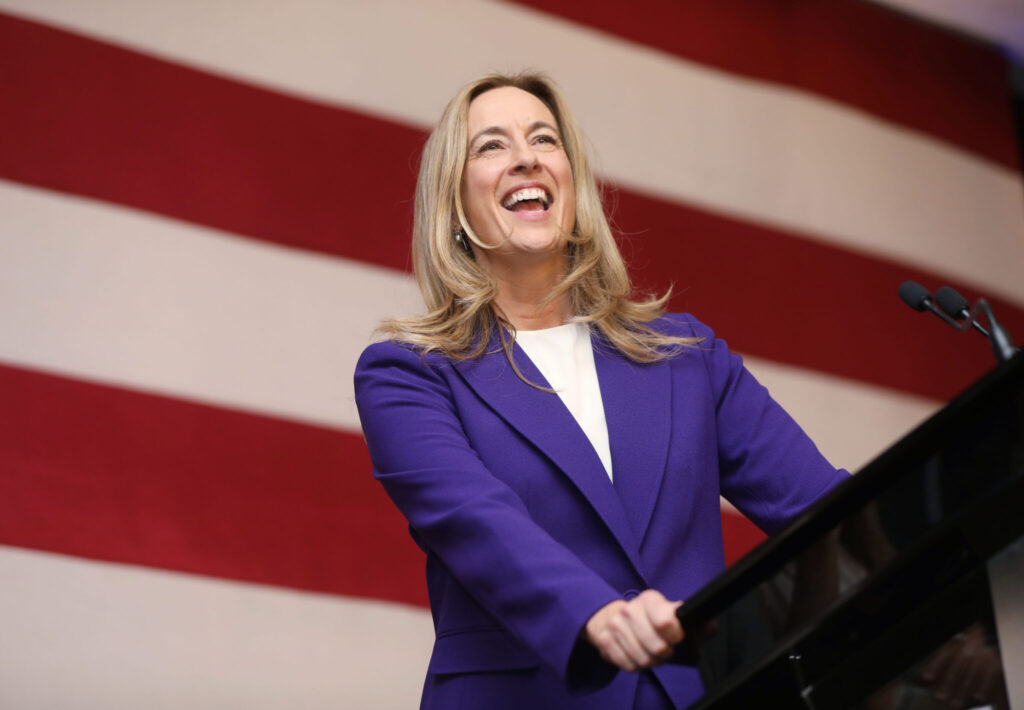
Democrats have secured a series of wins in this fall’s off-year elections, altering key city and state offices and raising new questions about the balance of power going into 2026. With Sherill’s and Spanberger’s gubernatorial wins in New Jersey and Virginia, and with results in statewide judicial races in Pennsylvania, results across the nation pointed in the same direction: more robust performances from Democratic candidates.
Upper School history teacher Dr. Matthew Bunn describes the recent surge in Democratic wins as a result of a larger tendency in American politics. In political science, it’s called “thermostatic public opinion. “If you think of a thermostat, [when] it’s too hot, [it] brings it back down, [when] it’s too cold, [it] brings it back up.” In practice, voters can often use midterm and off-year elections to balance out the political power held by the party that holds the White House.
This context helps explain why Democrats have gained popularity even in elections that were anticipated to be extremely close. According to Dr. Bunn, the country continues to be “closely divided”, so only a small increase in voters could change the electoral outcomes. With the recent elections, many voters appeared to treat these polls as a check on President Trump’s second term, as opposed to isolated local elections, revealing it was not “surprising” that the non-governing party performed well.
Turnout patterns also greatly contributed to the Democratic shift. Dr. Bunn observed that Trump’s support heavily relied on first-time or infrequent voters – people” who may not pay attention to politics or vote in smaller, off-cycle races. In contrast, lower-turnout polls are more likely to draw in “a more heavily educated electorate of like hardcore voters”, a population that has typically leaned Democratic in past decades. This trend has helped Democrats maintain political power through special elections when presidential races remain narrow.
Ideology within the Democratic Party differed greatly in these elections. In New York City, Zohran Mamdani, a progressive Democrat, became mayor, while moderate Democrats took the governor’s seats in Virginia and New Jersey. Rather than seeing this difference of ideology as conflicting, each candidate ran their campaigns on a shared focus on affordability. Democrats emphasized a lower cost of living, even as debates remain over whether citizens should expect prices to stabilize or return to pre-COVID levels.
Albeit the strong shift towards Democratic candidates, Dr. Bunn cautioned against interpreting the 2025 elections as a permanent change. Since around 2000, Bunn argues, America has been in a period of “very closely divided elections in which no party gains an upper hand for a very long time”. In this kind of environment, neither Democrats nor Republicans are locked into majority power, and both parties can lose or gain control in just two years.
For students at Germantown Academy, many of the off-year elections — ranging from governors to state supreme courts — may feel unimportant, but Dr. Bunn stressed how these races help contribute to how national policies are interpreted and enforced by states. The 2025 state elections, Bunn implied, give students insight into how turnout patterns, new ideologies, and changing political support can transform the political landscape before the 2028 presidential election.