
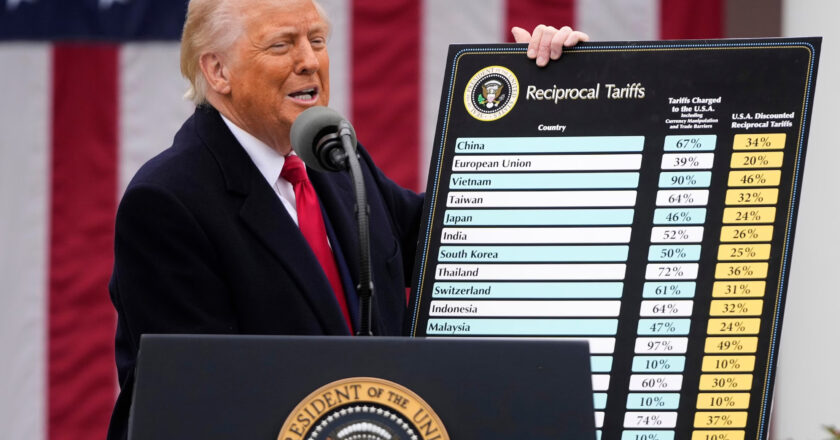


Since April 2, when Trump announced new sweeping tariffs, claiming they were reciprocal tariffs with a baseline of 10% on all imports and larger tariffs on China, South Korea, Japan, Taiwan, and the European Union (EU), the economy and stock market have faced tumult and destabilization. As some of the United States’ largest trading partners were hit by Trump’s tariffs, the administration’s decisions have greatly impacted the US.
A tariff is a duty or tax imposed on a foreign imported good by the government of the importing country. They are designed to protect domestic industries and increase government revenue.
On April 9, the tariff war between the US and China reached its highest point. The US heightened its total tariffs against China to 145%, while China promised to bring its tariffs to 84%. In the coming days, however, they would hike their tariffs up further to 125%.
This led to a lot of financial uncertainty and worry among Americans. During his campaign, Trump had promised to bring down prices immediately, and the tariffs were causing the opposite to occur. The stock market declined, and more Americans reported feeling increasingly worried after Trump’s reciprocal tariffs, according to polls conducted by ABC News and NPR. Trump’s approval rating had fallen to 39%, the lowest for a president in the first one hundred days of his tenure since President Franklin D. Roosevelt.
The stock market declined in the days after the reciprocal tariffs, as the Dow Jones Industrial Average fell 1.73% and the S&P 500 fell 2.24%.
“The stock market and its dramatic drop woke a lot of people up that maybe there isn’t a simple fix to the trade imbalances,” Mr. Jamie Murray, Upper School History teacher, said. “[The stock market] was a visual everybody could understand and created a lot of anxiety even for people who aren’t paying a lot of attention.”
“I don’t think the tariffs are a good idea, as they work against the American consumer,” Gavin Young ‘27 said. “It also hurts trade relations with foreign nations, who are our allies.”
After a meeting between the two countries in Geneva on May 12, China agreed to temporarily bring tariffs down to 10% while the US agreed to bring its tariffs back to 10% temporarily as well. Both sides recognized that the tariffs negatively impacted both of their economies, with companies and consumers both facing rising costs and disruptions in supply chains. This 90-day pause has led to a rebound in the stock market, as well as more consumer confidence.
Although the trade war with China was brief and a resolution was reached quickly, there is still worry about what a trade war between the two would do to the economies of other countries. The United States and China, having the first and second largest economies in the world, have a massive influence over the financial aspects of other countries, and tariffs could hurt other nations even more.
“If both countries suffer setbacks or go into recession, there’s a ripple effect where it’s a global economy and many smaller countries are dependent on trade with both China and the United States,” Mr. Murray said.
Amid the pause, relations between the US and China remain reserved. However, there was clear evidence of both sides being willing to reach a compromise.
“We need China, and China needs us, so I think we will continue to work together even though our political systems are dramatically different and we will have disagreements about our influence,” Mr Murray said.
As summer begins and foreign policy changes, it could affect the livelihoods of GA families, as prices could increase for longer periods of time. The potential for the tariff war to start again could impact many members of the GA community.
Sources:
https://www.cnn.com/2025/04/16/investing/us-stock-market
https://abcnews.go.com/Politics/trump-lowest-100-day-approval-rating-80-years/story?id=121165473