
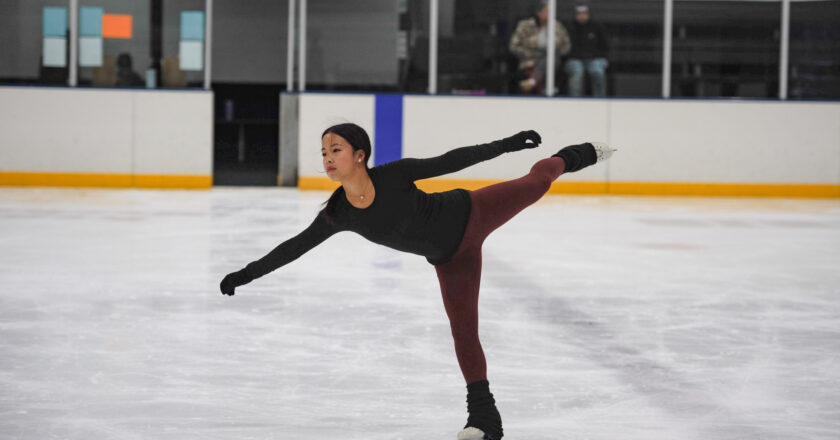

On Saturdays at Hatfield Ice Rink, Ashley Wang ‘26 can be seen gliding gracefully over the ice, performing elaborate spins, jumps and more as she hones her figure skating ability on a medium many people can barely move ten feet upright on.
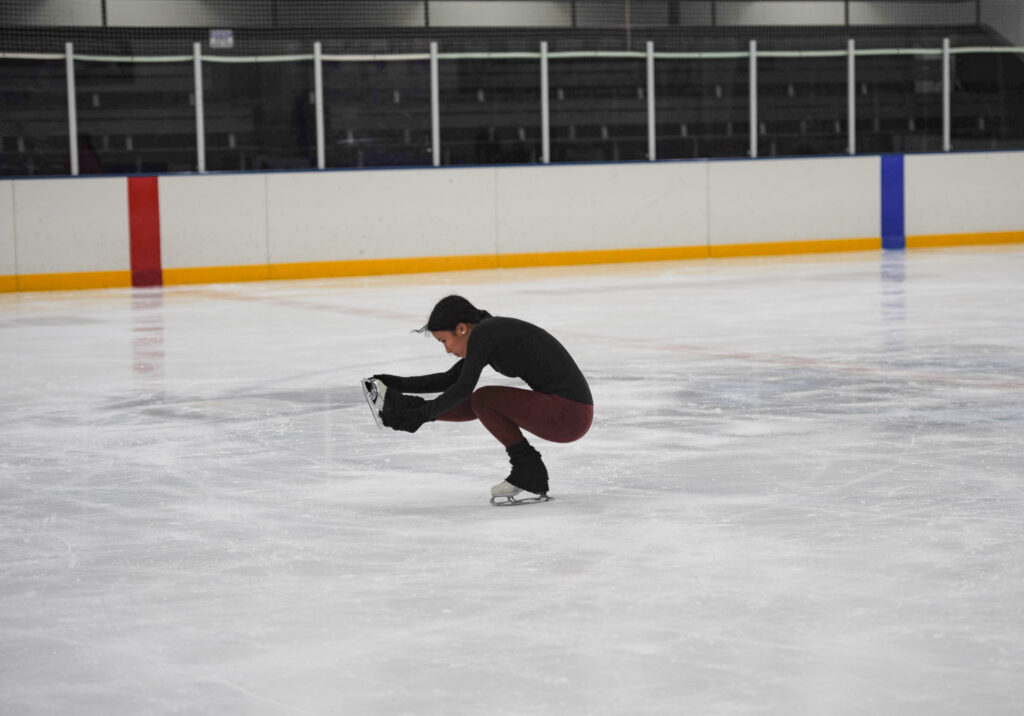
“For me, skating is really artistic,” Wang said. “Obviously it’s also a form of exercise, but I love doing my solo programs, getting to pick my music and talking to my coach about what moves I want to incorporate.”
Wang has been skating for upwards of eight years, first learning how to skate in order to spite a classmate. Afterwards, however, skating stuck with her and she began to skate more regularly.
“It’s actually kind of a funny story. So when I lived in China, someone in my grade invited me to a birthday party,” Wang said. “He and all of his friends played ice hockey, and when I went, they were all making fun of me because I couldn’t skate, and that made me want to learn how to skate just to spite them. That’s when I started taking lessons, and then I kept going.”
Wang continued to participate in group lessons, and her friends there introduced her to synchronized skating, or synchro, a competitive skating event where teams skate in elaborate, synchronized formations.
“I started skating more seriously, because I made friends in my group lessons and they introduced us to synchro,” Wang said. “I did synchro for about six years. I started at a program called Philadelphia Symmetry. With synchro, there’s different levels [based on age and ability], so I started going up the levels there.”
However, internal issues within Philadelphia Symmetry led to its dissolution three years later, prompting Wang and many other members to move to skating at Team Delaware, a more active and competitive program that provided Wang a higher level of competition and success.
“A lot of people from Philadelphia Symmetry moved to Team Delaware, which is where I skated for about three years,” Wang said. “With Team Delaware, we did more national competitions. We went to Anaheim in California every November and we went to Nationals one year in Salt Lake City, which was super fun.”
However, Wang ended her competitive career in ninth grade due to the high time commitment and is now focused on completing the United States Figure Skating (USFS) tests. Each of the USFS four categories—ice dance, pairs, freestyle, and moves in the field, the latter two of which are for solo skaters—have eight levels in order of increasing difficulty. Wang has already completed the moves in the field tests and is currently working on the freestyle tests, which are more open-ended and allow skaters to build their own programs.
“I had focused on finishing my moves in the field tests, which I did, and you get a title of USFS gold medalist,” Wang said. “Now I’m going through the levels for freestyle. It’s not really competing, but you do have to do testing where you record your programs and judges decide whether to pass you or not.”
“Completing all eight moves in the field levels is really hard and takes a lot of time and practice,” Rebecca Rong ‘26, former figure skater, said. “It’s really a testament to Ashley’s dedication and hard work that she was able to accomplish that.”
While the transition from synchro to solo skating has at times been difficult to navigate, Wang finds inspiration in her skating community to keep skating.
“Figure skating, for me, is like being a role model for younger kids, because it’s something I’ve done for so long and kind of gone through each stage for,” Wang said. “I started coaching for some of the group lessons that I used to do, and it’s just like my way of getting involved.”
Though Wang’s skating career has changed and developed over the years, what has always remained consistent is her connection and commitment to the community she’s found within figure skating, one that continues to motivate her growth.